


 admin
admin Climate risk has grown beyond scientific inquiry to become an economic, geopolitical, and societal issue. Governments legislate around it, corporations hedge against it, and global institutions debate it. However, meaningful solutions remain elusive in a field often dominated by rigid narratives, oversimplified policy, and escalating rhetoric. In this environment, leadership requires more than technical knowledge—it demands clarity, independence, and an ability to rethink foundational assumptions.
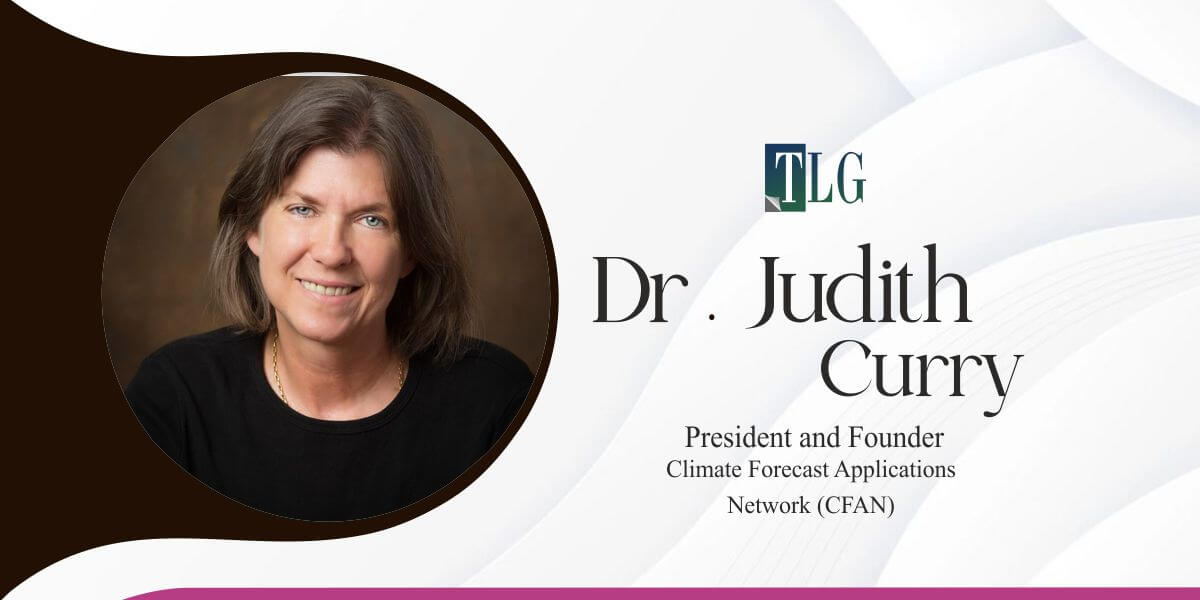
Judith Curry, President of Climate Forecast Applications Network (CFAN), exemplifies this kind of leadership. Her work reshapes the interface between climate science and decision-making, equipping industries and institutions with tools to navigate uncertainty rather than ignore it.
“We are managing climate risk more effectively by confronting uncertainty directly—forecasting what’s possible, not just what’s probable”
-Dr. Judith Curry
Academic Foundation with a Strategic Pivot
Before CFAN, Curry built a distinguished academic career, culminating in her role as Chair of the School of Earth and Atmospheric Sciences at the Georgia Institute of Technology. Her research in atmospheric dynamics, climate modeling, and uncertainty analysis earned her recognition as a leading climate scientist. Holding the title of Professor Emerita, she continues to influence the academic discourse, but her strategic pivot into applied science is what broadened her reach and operational impact.
In 2006, Curry transitioned from academia to entrepreneurship, founding CFAN through Georgia Tech’s VentureLab program. The aim was to transform research into actionable climate services—ones that prioritized precision, flexibility, and user-relevant insights.
CFAN: A New Model for Climate Services
CFAN was conceived to fill a gap in climate services: real-time, long-lead forecasts that combine technical depth with decision utility. The company leverages ensemble modeling, artificial intelligence, and statistical-dynamical approaches to deliver extended-range forecasts and probabilistic assessments of climate and weather extremes.
Its initial focus on extreme weather forecasting quickly expanded into a multi-sector portfolio:
- OmniCast supports the energy sector with forecasts for temperature, solar radiation, wind, and severe convective weather. These insights are integrated into grid management and energy trading systems.
- TropiCast enhances tropical cyclone forecasting through tools that quantify uncertainty, assess storm intensification, and estimate landfall damage potential.
- AgriCast delivers threshold-based weather forecasts tailored for precision agriculture, enabling smarter planning under uncertain seasonal conditions.
CFAN’s platforms are distinguished by their visualization tools, forecast calibration methods, and cognitive analytics. These features convert complex outputs into intuitive decision aids, improving user interpretation and response.
Forecasting as Risk Navigation
CFAN’s work is grounded in a central principle: uncertainty is not an obstacle but a parameter that must be integrated. Curry’s leadership is defined by this scientific pragmatism. Rather than presenting single-outcome predictions, CFAN provides probabilistic forecasts that map a range of plausible futures—essential for sectors sensitive to both long-term climate trends and short-term weather disruptions.
By treating uncertainty as a strategic asset, CFAN enables clients to weigh probabilities, assess vulnerabilities, and plan with clarity. This framework empowers companies, governments, and institutions to act with foresight rather than react to crisis.
A Clearer Lens on Climate Risk
Curry’s influence extends beyond operational tools to the public discourse surrounding climate change. Over time, she has consistently advocated for a more balanced understanding of climate risk—one that acknowledges the full complexity of natural and human-induced variability, and one that differentiates between slow-evolving trends and immediate hazards.
Her critique of contemporary climate narratives centers on their tendency to overstate certainty and underplay adaptive capacity. Rather than deny the role of greenhouse gas emissions, her approach calls for a more layered view—where natural variability, human adaptability, and socioeconomic context shape the policy landscape.
This perspective is not ideological, but analytical. It emphasizes that managing climate risk effectively requires confronting the nuances: separating emergency hazards from long-term trajectories, prioritizing local resilience, and making room for diverse regional strategies.
The Book That Reframes the Debate
The publication of Climate Uncertainty and Risk marked a turning point in Curry’s mission to reshape how society interprets and responds to climate challenges. The book argues that current approaches to climate risk suffer from both oversimplification and overconfidence, resulting in policy decisions that often prioritize symbolism over effectiveness.
It offers an alternative framework based on systems thinking and risk management. By integrating deep uncertainty into climate governance, the book provides a path for formulating adaptive strategies that are both scalable and context-sensitive. It has been particularly well-received by professionals seeking to build more resilient infrastructure, energy systems, and urban environments.
Global Development and Energy Equity
Another dimension of Curry’s leadership lies in her call for climate policy that respects development priorities. She has raised concerns about the unintended consequences of redirecting global development funds primarily toward emissions reductions at the expense of basic infrastructure and energy access in low-income regions.
Her argument underscores the importance of development-first strategies, where emissions targets do not override the need for reliable, affordable energy. She frames the climate conversation not as a uniform mandate but as a differentiated challenge—where each region requires a tailored mix of mitigation, adaptation, and economic investment.
Rather than championing a single pathway, Curry supports an integrated approach to energy policy—one that includes conventional and renewable sources, technological innovation, and realistic timelines for transition.
“Climate policy must empower development, not restrict it. Reducing energy poverty is inseparable from building long-term environmental resilience”
-Dr. Judith Curry
A Model of Independent Leadership
Judith Curry has consistently demonstrated that scientific leadership is not about reinforcing dominant narratives, but about asking harder questions, identifying blind spots, and delivering tools that serve real-world decision-makers.
Her work through CFAN continues to influence infrastructure planning, disaster response, litigation, agricultural strategy, and corporate risk disclosure. From the granular detail of cyclone intensification to the macro-view of climate governance, Curry’s career is a study in depth, integrity, and long-term impact.
Her leadership challenges the belief that urgency must come at the cost of precision. Instead, it shows how climate progress depends on realism, adaptability, and a willingness to rethink even the most entrenched assumptions.
 Magazine