


 admin
admin 
Astronomers Detect Interstellar Sugar Erythrulose, Revealing Unexpected Prebiotic Chemistry Before Stars and Planets Form
Quick Summary
Astronomers have detected interstellar sugar erythrulose in a giant molecular cloud near the Milky Way’s center. The discovery marks the first confirmed detection of a true sugar in interstellar space. Scientists believe this molecule formed on icy dust grains long before stars and planets existed.
The finding also suggests that early planetary systems may have received complex organic molecules through comets and asteroids. Researchers now believe sugar formation in space follows a different chemical pathway than previously expected. This breakthrough opens new possibilities for understanding the chemical origins of life.
Introduction
The interstellar sugar erythrulose discovery has changed how scientists view chemistry in deep space. Researchers identified the first true sugar inside a giant molecular cloud using advanced radio telescopes. The finding shows that complex organic molecules can develop much earlier than scientists once believed.
It also strengthens the idea that important ingredients for life existed before planets even formed. Scientists now plan to study similar molecular clouds to search for even more complex sugars and organic compounds. These discoveries could answer important questions about the earliest stages of planetary formation and life’s chemical beginnings.
How Scientists Detected Interstellar Sugar Erythrulose
Researchers observed the giant molecular cloud G+0.693-0.027 using two powerful radio telescopes. Every rotating molecule releases radio signals at unique frequencies. Scientists compared those signals with laboratory measurements of erythrulose and found multiple matching patterns.
The laboratory work presented another challenge. Sugars easily break apart during vaporization. Researchers solved this problem by mixing erythrulose with talc before spectroscopic testing. This method allowed intact sugar molecules to enter the gas phase and produce reliable measurements. Scientists also examined more than 180 molecular species before confirming the sugar’s identity.
Why The Interstellar Sugar Discovery Matters
Scientists previously detected molecules connected with amino acids, ribonucleotides, and other prebiotic compounds. However, they had never identified a true sugar in interstellar space. This discovery expands the understanding of chemical reactions taking place inside icy molecular clouds.
Researchers believe these sugars formed on frozen dust grains over millions of years. As molecular clouds eventually collapsed, they created new stars and planetary systems. Comets and asteroids may have carried these organic molecules to young planets, including the early Earth. This possibility strengthens theories about how life’s chemical ingredients spread across space.
Unexpected Chemistry Challenges Existing Models
Scientists expected simpler three-carbon sugars to appear before larger sugar molecules. Instead, they discovered the four-carbon sugar erythrulose. Even more surprising, erythrulose appears much more abundant than similar three-carbon sugars.
This unexpected result has forced researchers to reconsider earlier chemical models. Instead of building larger sugars one carbon atom at a time, two smaller molecules may combine directly on icy dust grains. Scientists believe glycolaldehyde and ethylene glycol could react together under extremely cold interstellar conditions. Computer simulations also supported this proposed chemical pathway.
What This Means For Future Space Research
The discovery gives scientists new targets for future observations. Researchers now plan to search for larger sugars and other complex organic molecules across molecular clouds. New findings could explain how increasingly complex chemistry developed before planetary systems formed.
Scientists also expect this breakthrough to improve astrochemical models. Future laboratory experiments and telescope observations may uncover additional molecules that shaped the earliest stages of planetary evolution.
FAQs
1. What is erythrulose?
Erythrulose is a naturally occurring four-carbon monosaccharide, also known as a simple sugar. It is the first confirmed true sugar detected in interstellar space.
2. Where did scientists discover interstellar sugar?
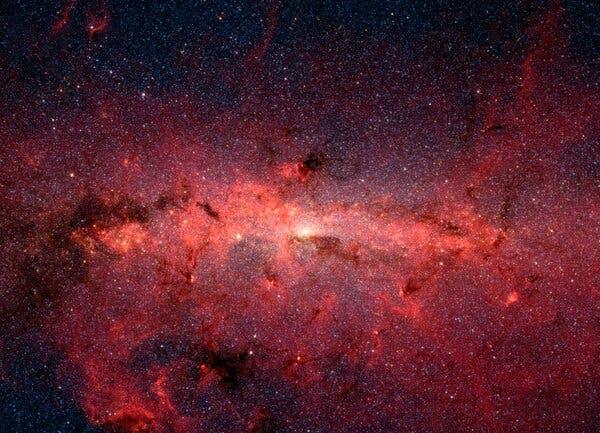
Researchers detected erythrulose inside the giant molecular cloud G+0.693-0.027, located near the center of the Milky Way galaxy.
3. Why is this discovery significant?
The discovery shows that complex sugars can form before stars and planets exist. It also supports the idea that important organic molecules developed much earlier than scientists once believed.
4. How did astronomers confirm the sugar’s presence?
Scientists matched radio signals from the molecular cloud with laboratory spectroscopic measurements. Multiple matching molecular signatures confirmed the presence of erythrulose.
5. What will scientists study next?
Researchers will continue searching for larger sugars and other organic molecules in interstellar clouds. These studies may reveal more about the chemical origins of planetary systems and life.
Key Takeaways
- Astronomers detected a four-carbon interstellar sugar for the very first time.
- The discovery occurred inside a massive molecular cloud near our galactic center.
- This finding proves complex sugars form long before planets or stars exist.
- The sugar likely forms when two-carbon molecules react on icy dust grains.
- Comets potentially transferred these vital prebiotic building blocks to the early Earth.
Conclusion
The interstellar sugar erythrulose discovery marks a major milestone in astrochemistry. It shows that deep space supports much more complex chemistry than previously understood. The finding also suggests that important building blocks for life existed before the birth of stars and planets.
Scientists now have fresh evidence that young planetary systems may have inherited these molecules from ancient molecular clouds. As research continues, future discoveries could reveal even more about the chemical history of the universe and the origins of life’s essential ingredients.
 Magazine